






Test HRP Design
Behind the Design
The making of The Palace Collection, took years to create. Join us as we take a look at the processes behind these intricate jewellery designs.
Inspired by History
They say history is always around us – but what if it could be upon us as well? This new partnership between Boodles and Historic Royal Palaces unites two iconic British institutions in celebration of history and craft. Our Director of Design, Rebecca Hawkins, and Boodles designers have created a collection which makes the past wearable and thrillingly present. Thanks to exclusive behind-the-scenes access to Hampton Court Palace, Kensington Palace, the Tower of London, Kew Palace and Hillsborough Castle, we’ve brought the centuries to life with this new collection.

Keeping History Alive
Britain’s royal palaces keep history alive. Walking through Kensington Palace, entering the opulent Presence Chamber is to be transported to the early eighteenth century. Our team were inspired by its ceiling, painted by the master artist William Kent. King George I would have admired the mythological motifs: winged harpies, sphinxes and fronds. Together with its bold red diagonals, these inspired us to work rubies, tourmalines and Single Mine Origin yellow gold into earrings and necklaces fit for a monarch.

In Hampton Court Palace, each room inhabits an idea. In collaboration with the curators, Rebecca and our design team have taken porcelain from Asia and reinterpreted its oriental colour schemes and leaf motifs. Blue sapphires and pear shaped diamonds mirror Queen Mary II’s treasured collection of porcelain.
While it draws on the past, this collection is designed for the present. One of our most striking pieces, the Silk Mantua necklace, is based on a distinctive design created in Spitalfields for a noblewoman of the mid-1750s. It would have taken up to a year to create with its brocaded silk featuring intricate floral motifs, showcasing the technical mastery of England’s silk weavers working in the century Boodles began.
Exploring the cloisters and courts of the palaces is an opportunity to take something historic and give it new life. Seeing the Royal Beast statues at Hampton Court Palace may not have been the most obvious point of inspiration, but our designers imagined them coming to life after dark, once the last tourists are free from the Maze. Recreating the mythical yales from the Moat Bridge and Chapel Court Garden
presented one of the most demanding technical challenges in Boodles’ 228-year history. Two leaping creatures, handcarved, frolic in front of triangular trees made of diamonds in an emerald garden recalling Inigo Jones.


Strolling back through the East Front Garden, you reach a greenhouse: home to Hampton Court’s famous Great Vine. Planted by Lancelot ‘Capability’ Brown in 1768, its distinctive dark dessert grapes are still harvested today. We’ve pressed them into juicy rhodolite garnets, with greenery in the form of cushion shaped peridots and leaves made from Single Mine Origin yellow gold.
These pieces are another example of our designers striving for perfection. It took many rounds of casting in gold to create a final form and texture reminiscent of the limewood carvings by Grinling Gibbons – the man behind the most celebrated woodwork of the late-seventeenth and early-eighteenth centuries. And just one of so many expert craftspeople employed to beautify the palaces.
In a tribute to craft, past and present, we’ve taken the stories of history and retold them afresh for today. The Mary of Modena bed is believed to be where Queen Mary II spent her last hours at Kensington Palace, while her beloved husband King William III kept watch beside her in a camp bed. Blue zircons, brilliant cut garnets and a sweetshop of sapphires now reflect their deep love in our Royal Damask jewellery.

Our partnership with Historic Royal Palaces has offered Boodles’ designers privileged access to places usually off limits to inquisitive eyes. Queen Charlotte’s Cottage is a rustic hideaway, hidden in a southwestern corner of Kew Gardens, near Richmond. Its interior is magical. George III and Queen Charlotte’s daughter, Princess Elizabeth, painted the trellis decoration with an artist friend in 1804. The way its pretty flowers rise up the walls and curve across the ceiling inspired our design team to take cabochon mandarin garnets, brilliant cut green, yellow and blue sapphires, and – in the case of our long necklace – 562 (!) brilliant cut diamonds to create works of high jewellery befitting the cottage’s parabolic and enchanting inner peak.
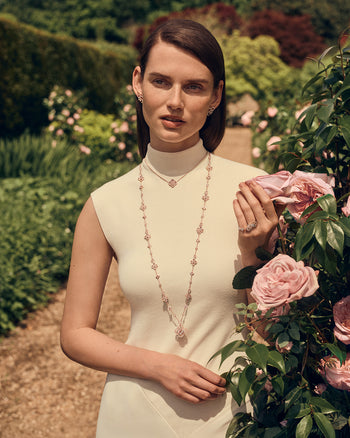
And at each stage, Boodles’ Joint Managing Directors (and cousins) James Amos and Jody Wainwright inspect the progress underway at our London workshop, paying attention to the details people so often cherish most. Such as the way a Boodles ring looks as beautiful from behind, or from the sides, as from the front. Or how a Boodles necklace curves around the collar, soft as ribbon. Because we – like the patrons of palaces – see our jewellery not simply for the here-and-now, but as something to endure for generations. Forever part of a family story.
“This is, without doubt, the most exciting and intricate high jewellery collection we have ever created.”


